
Novartis Setbacks: What Do They Mean For Pharma Innovation?
By line: Kinza Tahir, Maria Malik & Amna Naseer
Industry Leaders weigh in on risk, validation, and what pharma must learn from this moment.
September 2026 has brought several notable pipeline challenges for Novartis. Within days, the company reported three major pipeline setbacks: the Phase III HARBOR study of del-desiran in myotonic dystrophy type 1 failed to meet its primary endpoint; the Phase III Lp(a)HORIZON trial of pelacarsen did not demonstrate a reduction in cardiovascular events despite lowering lipoprotein(a); and multiple studies of the investigational CAR-T therapy rap-cel were paused following patient safety concerns.
While these developments represent important clinical disappointments, Novartis continues to advance numerous late-stage and commercial programs across oncology, cardiovascular, immunology, and neuroscience.
The setbacks drew significant investor attention and renewed discussion about pipeline risk, portfolio concentration, acquisition strategy, and the challenges of managing scientific uncertainty.

The Bigger Question for Pharma
This series of high-profile clinical setbacks has reignited a familiar question across the industry: are these isolated disappointments or signs of a broader challenge in pharmaceutical innovation?
Green Minds asked industry leaders for their perspective.
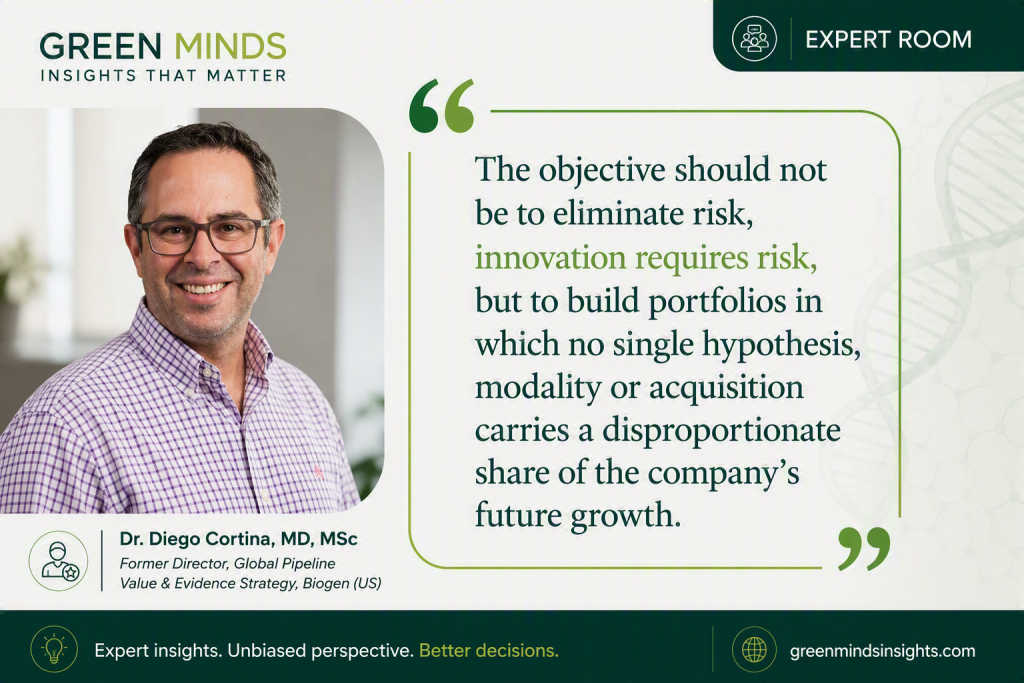
“Innovation Requires Risk, But Portfolios Need Balance”
Sharing his perspective, Dr. Diego Cortina, MD, MSc – Former Director, Global Pipeline Value & Evidence Strategy, Biogen (US) said it is both a difficult moment for Novartis and a broader lesson for the industry.
“These were different assets, modalities and failure modes, so I would be cautious about interpreting them as one systemic problem. However, they illustrate how increasingly concentrated pipelines rely on a relatively small number of high-value, scientifically ambitious programs.”, said Dr. Cortina.
He notes that strong biology, biomarkers, and early-phase data do not always translate into clinical success, and that acquisitions provide access to innovation but cannot eliminate scientific risk.
“M&A Can Never Replace Scientific Validation”
A former Innovative Medicines International executive, who agreed to be quoted anonymously, sees the setbacks as a reminder that licensing and acquisitions cannot replace rigorous scientific validation.
“External growth strategies can rapidly expand pipeline capacity, but M&A and licensing deals can never substitute for uncompromising target validation, translational evidence, and biological differentiation.”
The expert emphasizes that both internally developed and externally acquired assets can fail, reinforcing one central lesson:
“Pipeline resilience depends not on where a candidate originates, but on the relentless, independent interrogation of its mechanistic rationale, clinical proof, and disease differentiation.”


“The biggest mistake in pharma is confusing promising science with proven patient value.”
A Pfizer Country Lead, who agreed to be quoted anonymously, highlighted another critical lesson for the industry: the distinction between promising science and demonstrated patient value.
Strong biology and encouraging early signals still need to survive rigorous validation around target selection, patient population and endpoint choice.
The expert’s key takeaway was that setbacks are part of innovation; what matters is how quickly companies learn, adapt and redirect resources toward the opportunities with the strongest evidence and patient impact.
The Green Minds Take
Despite approaching the issue from different angles, all experts agree on one thing: science remains the ultimate determinant of success in drug development.
Whether an asset is built, bought, or licensed, no amount of investment can replace rigorous target validation, strong translational evidence, and disciplined clinical execution.
Bottom line: The recent Novartis setbacks highlight the inherent uncertainty of drug development and reinforce a broader industry lesson: whether assets are discovered internally, licensed, or acquired, long-term success ultimately depends on scientific rigor, clinical validation, and the ability to continuously reassess assumptions as evidence evolves.