
What Do Novartis Recent Clinical Setbacks Reveal

Novartis has faced a series of high-profile clinical setbacks, reigniting a familiar question across the industry: are these isolated disappointments or symptoms of a broader challenge in pharma innovation?
Green Minds asked industry leaders for their perspective.
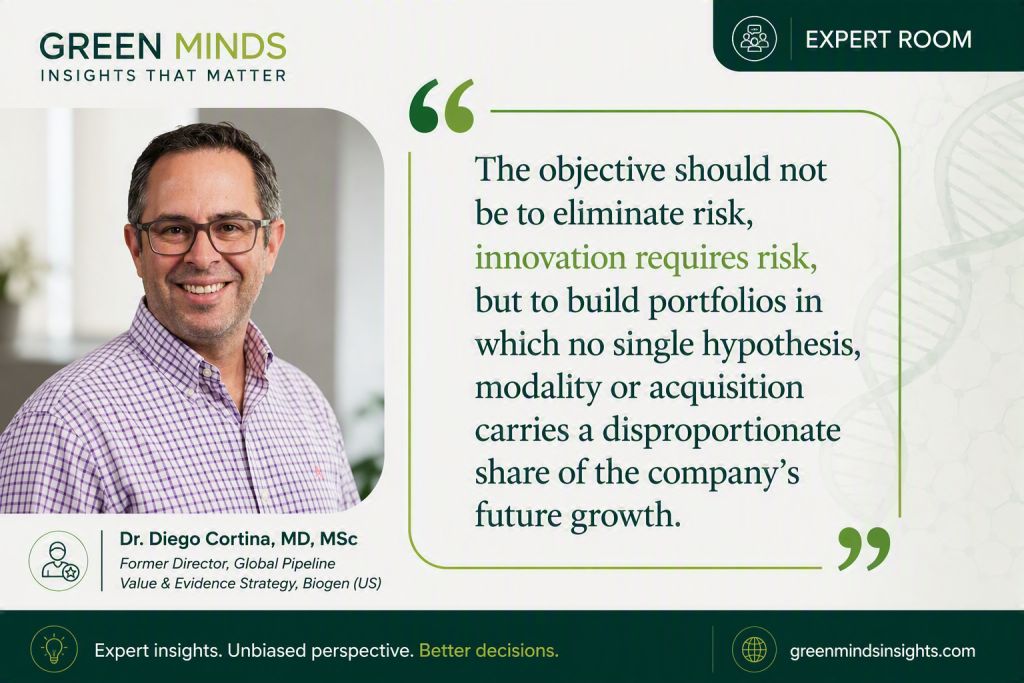
“Innovation Requires Risk, But Portfolios Need Balance”
Dr. Diego Cortina, MD, MSc
Former Director, Global Pipeline Value & Evidence Strategy, Biogen (US)
Dr. Cortina believes this is both a difficult moment for Novartis and a broader lesson for the industry.
“These were different assets, modalities and failure modes, so I would be cautious about interpreting them as one systemic problem. However, they illustrate how increasingly concentrated pipelines rely on a relatively small number of high-value, scientifically ambitious programs.”
He notes that strong biology, biomarkers, and early-phase data do not always translate into clinical success, and that acquisitions provide access to innovation but cannot eliminate scientific risk.
“M&A Can Never Replace Scientific Validation”
A former Innovative Medicines International executive (Novartis arm for pharma) sees the setbacks as a reminder that licensing and acquisitions cannot replace rigorous scientific validation.
“External growth strategies can rapidly expand pipeline capacity, but M&A and licensing deals can never substitute for uncompromising target validation, translational evidence, and biological differentiation.”
The expert emphasizes that both internally developed and externally acquired assets can fail, reinforcing one central lesson:
“Pipeline resilience depends not on where a candidate originates, but on the relentless, independent interrogation of its mechanistic rationale, clinical proof, and disease differentiation.”
The Green Minds Take
Despite approaching the issue from different angles, both experts agree on one thing: science remains the ultimate determinant of success in drug development.
Whether an asset is built, bought, or licensed, no amount of investment can replace rigorous target validation, strong translational evidence, and disciplined clinical execution.
Bottom line: The Novartis setbacks are less about where innovation comes from and more about the industry’s ability to challenge assumptions before placing billion-dollar bets on them.